Energy-efficient lighting is one of the easiest ways to cut energy consumption without sacrificing comfort or function. Yet people often talk about «big savings» without actually doing the math. And then the classic thing happens: the decision is postponed because it all sounds a little too good to be true. Let’s break it down. Here you’ll find practical numbers, a simple method for calculating the benefits, and which measures usually have the most effect, both at home and in commercial buildings.
When we talk about saving on lighting, it’s about three things: how much power (watts) you use, how long the light is on (hours), and how smartly you control its use. LED is the foundation, but control is often the «turbo» that makes the savings brutal in practice. For some premises, LED alone is enough to halve energy use. For others, it’s control that removes the «invisible hours» when the light is on when no one needs it. The electricity bill doesn’t care about intentions, it only counts kilowatt hours.
Why lighting is often low-hanging fruit
Many people assume that lighting is a small part of the total consumption, especially in homes. That may be true, but «small part» does not mean «insignificant». In commercial buildings, lighting can make up a significant proportion, especially in premises with long opening hours, warehouses, production, office spaces and common areas. And it is precisely hours that are key: a light that is on for 3 hours a day is something completely different from one that is on for 12–16 hours, year-round.
In addition, there is a bonus that many people forgot: less heat generation. Traditional light sources (halogen, incandescent bulbs and some older fluorescent tube solutions) convert much of the energy into heat. LED converts more of the energy into light. This means lower cooling requirements during periods when the premises would otherwise need to be cooled, typically in shops, offices and server/technical rooms with temperature requirements. So you get an indirect saving in addition to the direct one.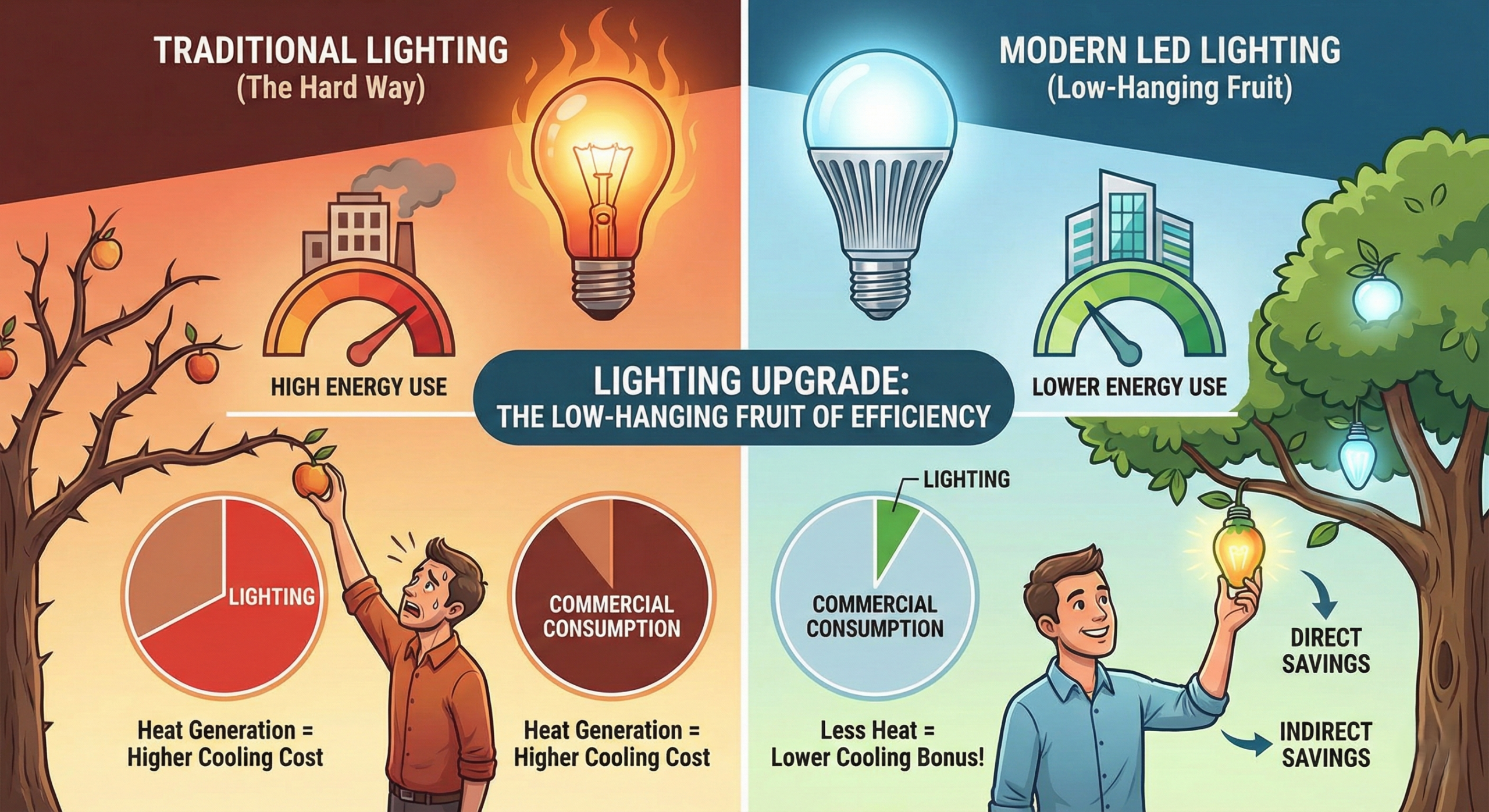
Savings calculation
The practical formula is simple:
Annual energy use (kWh) = Power (kW) × Operating time (hours/year)
And cost: kWh × electricity price (NOK/kWh)
Let’s say you have 100 fixtures or light sources. Before: 58 W fluorescent fixtures. After: LED solution that provides the same light level with an average of 25 W.
- Before: 100 × 58 W = 5800 W = 5.8 kW
- After: 100 × 25 W = 2500 W = 2.5 kW
- Difference: 3.3 kW saved when everything is on
If the operating time is 3000 hours/year (typical office/workshop-ish), the annual savings will be:
- 3.3 kW × 3000 h = 9900 kWh/year
With a total electricity price (energy + network + fees) of, for example, NOK 1.50/kWh, the savings will be:
- 9,900 kWh × 1.50 = NOK 14,850/year
And this is without control. If you add motion or presence sensors in areas that are in practice overused (toilets, warehouses, corridors, meeting rooms), you can often cut operating time by 20–60% in those zones. This is where the really «unfair» calculations come from, the ones that make the measure pay for itself quickly.
Concrete scenarios: what can you save in practice?
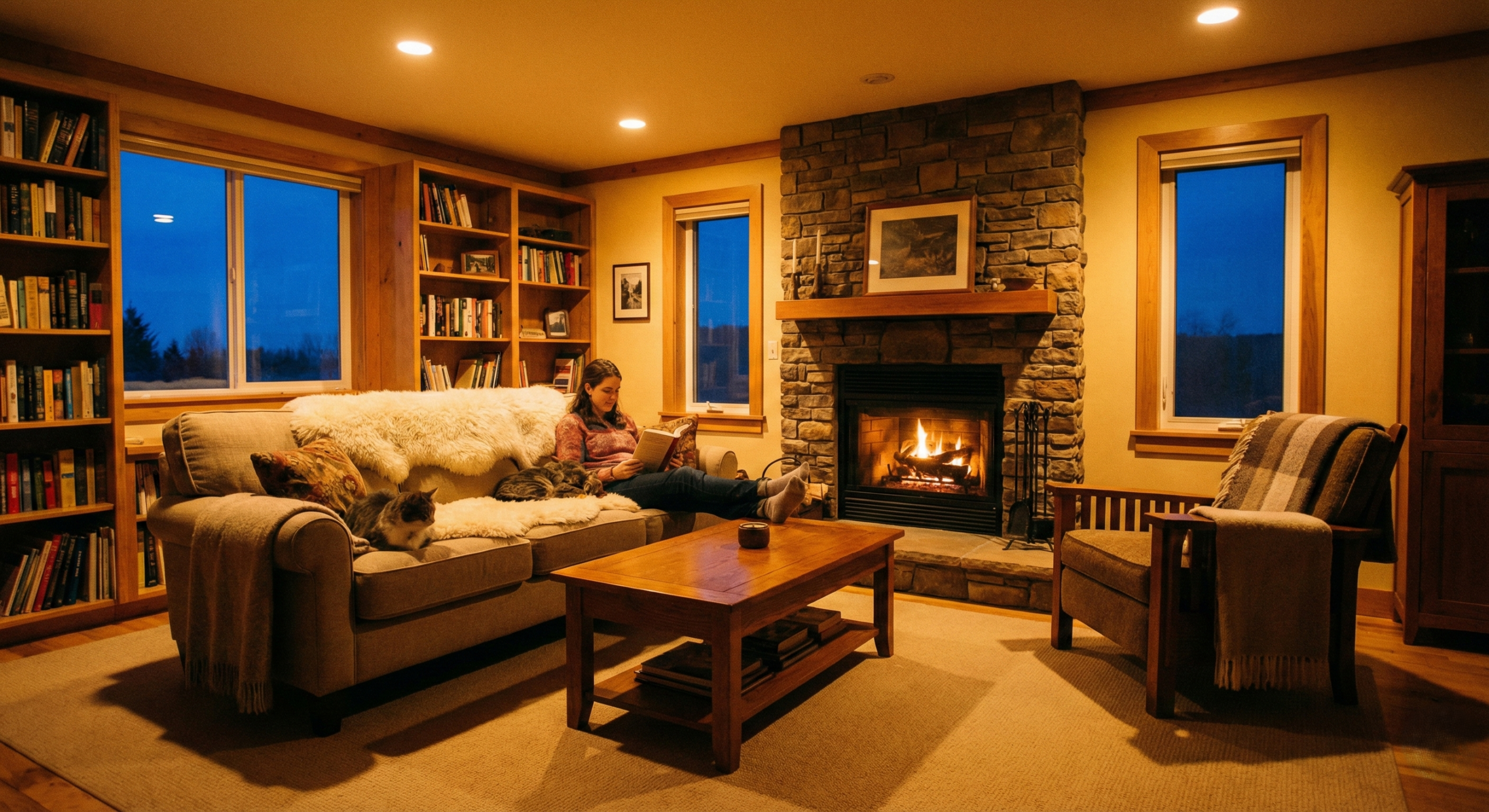
1) Housing: from halogen to LED (spots and downlights)
Halogen spotlights are a power thief with nice light. Many people still have 20–40 halogen spots at home.
Example: 30 spotlights, 35 W halogen, average 3 hours per day:
- Before: 30 × 35 W = 1050 W = 1.05 kW
- Operating time: 3 h/day × 365 = 1095 h/year
- Annual use: 1.05 × 1095 = 1150 kWh/year
If you switch to a 5W LED with the same perceived light (assuming the correct lumens, spread and color temperature):
- After: 30 × 5 W = 150 W = 0.15 kW
- Annual use: 0.15 × 1095 = 164 kWh/year
Savings: approx. 986 kWh/year .
At NOK 1.50/kWh: approx. NOK 1,480/year saved.
It’s not «life-changing», but it’s real, and you’ll avoid frequent bulb changes and heat generation. And yes: you’ll also have fewer opportunities to stand on a ladder and regret your own life choices.
2) Office: LED panels + daylight control
Offices often have long hours and large spaces.
Example: 2000 m² office, older solution 10 W/m² on average for lighting (conservative), operation 2500 hours/year:
- Before: 2000 × 10 W = 20,000 W = 20 kW
- Annual usage: 20 × 2500 = 50,000 kWh
If you upgrade to energy-efficient lighting with LED and better optics, you can get down to 4–6 W/m² in many projects, depending on requirements and light level. Let’s say 6 W/m²:
- After: 2000 × 6 W = 12 kW
- Annual use: 12 × 2500 = 30,000 kWh
Savings: 20,000 kWh/year .
Cost savings at NOK 1.50/kWh: NOK 30,000/year .
If you also add daylight control in zones with windows, you can cut even more, often by 10-30% in the relevant zones. Not because the technology is magical, but because daylight is actually free, and it’s stupid to pay for light you already get through the window.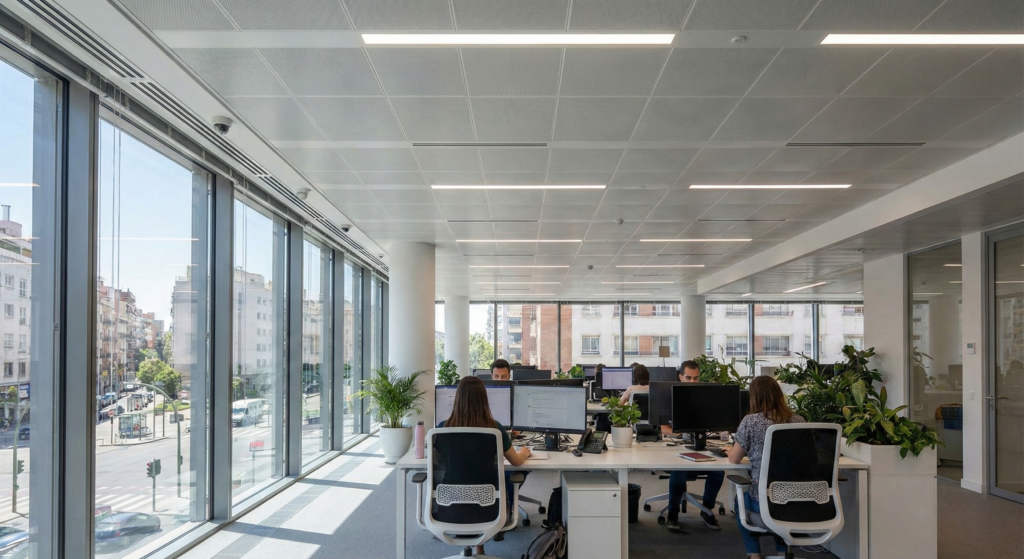
3) Warehouse and logistics: LED high-bay + motion sensor
Warehouses are a classic. High ceilings, lots of lighting, and often lights on «for safety’s sake.»
Example: 50 high-bay luminaires, before 250 W, after 120 W LED with correct light distribution:
- Before: 50 × 250 W = 12.5 kW
- After: 50 × 120 W = 6.0 kW
- Power saved: 6.5 kW
Operating time without control: 4000 h/year:
- Savings: 6.5 × 4000 = 26,000 kWh/year
- NOK: 26,000 × 1.50 = NOK 39,000/year
With motion sensors and zone control, actual operating time can often be reduced significantly, especially in aisles and areas with occasional traffic. If you reduce «full on» to 2500 hours and have a dimmed background level otherwise, you can get even more out of it. This is where many projects have a short payback time, because you are reducing both watts and hours 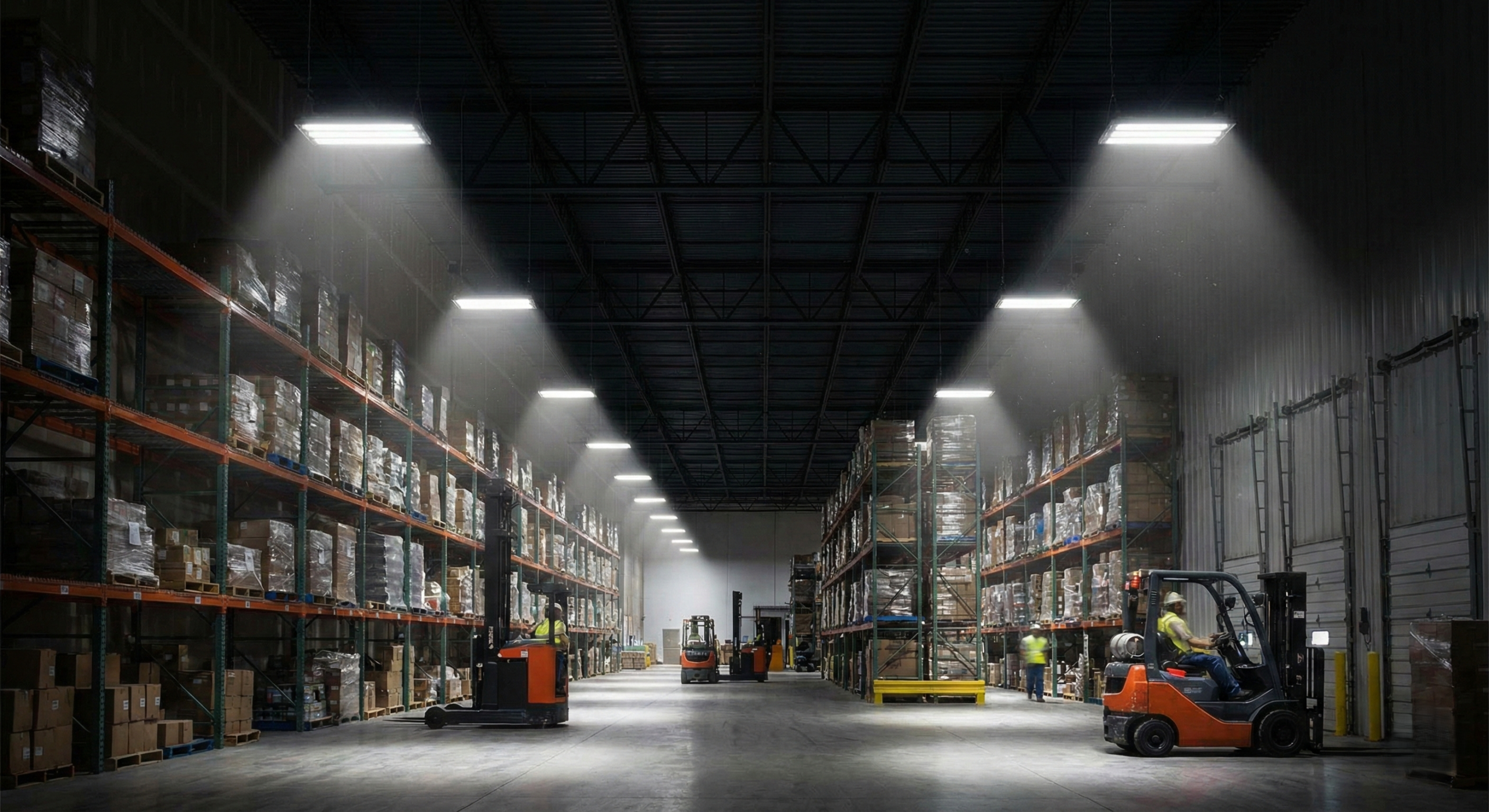 .
.
Common mistakes people make
The most common mistake is to trade «watts for watts» without ensuring the correct amount of light and light distribution. Watts only tell you how much power something draws, not how much light you get. You have to think about lumens , the optics of the fixture, and the actual light on the work surface (lux). If you choose too dimly, you end up compensating by having more light on, or supplementing with extra fixtures. If you choose the wrong distribution, you get a lot of light on the ceiling and not enough where you need it. Then the whole point is lost.
Another classic: incorrect color temperature and poor color rendering (CRI). The result is dissatisfaction and «LED is cold and ugly» stories. It is rarely about LED as a technology, but about incorrect specifications. For stores and showrooms, CRI can be a direct sales driver. For offices, it affects well-being. For warehouses and industry, it is about safety and clarity.
In the end: no one takes control. You make an expensive upgrade, but leave everything as it is. Then you only get half the effect of the project. If you are going to invest first, do it properly: map out zones, usage patterns and where automation will bring benefits.
A simple business case template you can use
To assess energy-efficient lighting without getting bogged down in detail, you need:
- Number of light sources/luminaires and power today (W)
- Estimated power after upgrade (W) with the same light level
- Annual operating time (hours/year) per zone
- Electricity price (NOK/kWh) that you use in the calculation
- Investment (NOK) incl. installation, possibly management
- Maintenance effect (less bulb changes, less downtime)
Then you calculate annual savings in kroner, and find the simple payback period:
Payback period (years) = Investment / annual savings
In many normal projects, the payback period is often in the range of 1–5 years, but it varies a lot with operating time and how «old» the solution is. The key word is operating time: the more hours the light is on, the faster it pays off.
What should you prioritize first?
If you want maximum effect per kroner, prioritize areas with:
-
Many operating hours (warehouse, corridors, shop, common areas, outdoor lights that are left on for a long time)
-
Older light sources (halogen, old fluorescent fixtures, inefficient drivers)
-
Unpredictable use (meeting rooms, toilets, stalls, technical rooms), where control eliminates “forgotten on” hours
This is rarely sexy, but it’s where the money is. And yes, it’s a bit like cutting subscriptions you never use. Not glamorous, but effective.
Summary: what can you save in practice?
Energy-efficient lighting often results in 50–80% lower energy consumption on the lighting itself when you switch from older solutions to properly dimensioned LED. In practice, this means anything from a few thousand kroner a year in a home with many halogens, to tens or hundreds of thousands in commercial buildings with large areas and long operating times. If you add smart lighting control, it is often the operating time that collapses, and then the savings increase even further.
If you take one thing with you: Don’t buy «cheap watts». Buy the right light, with the right specification and control. Then the math will be both nice and true.