 What is an LED panel, exactly?
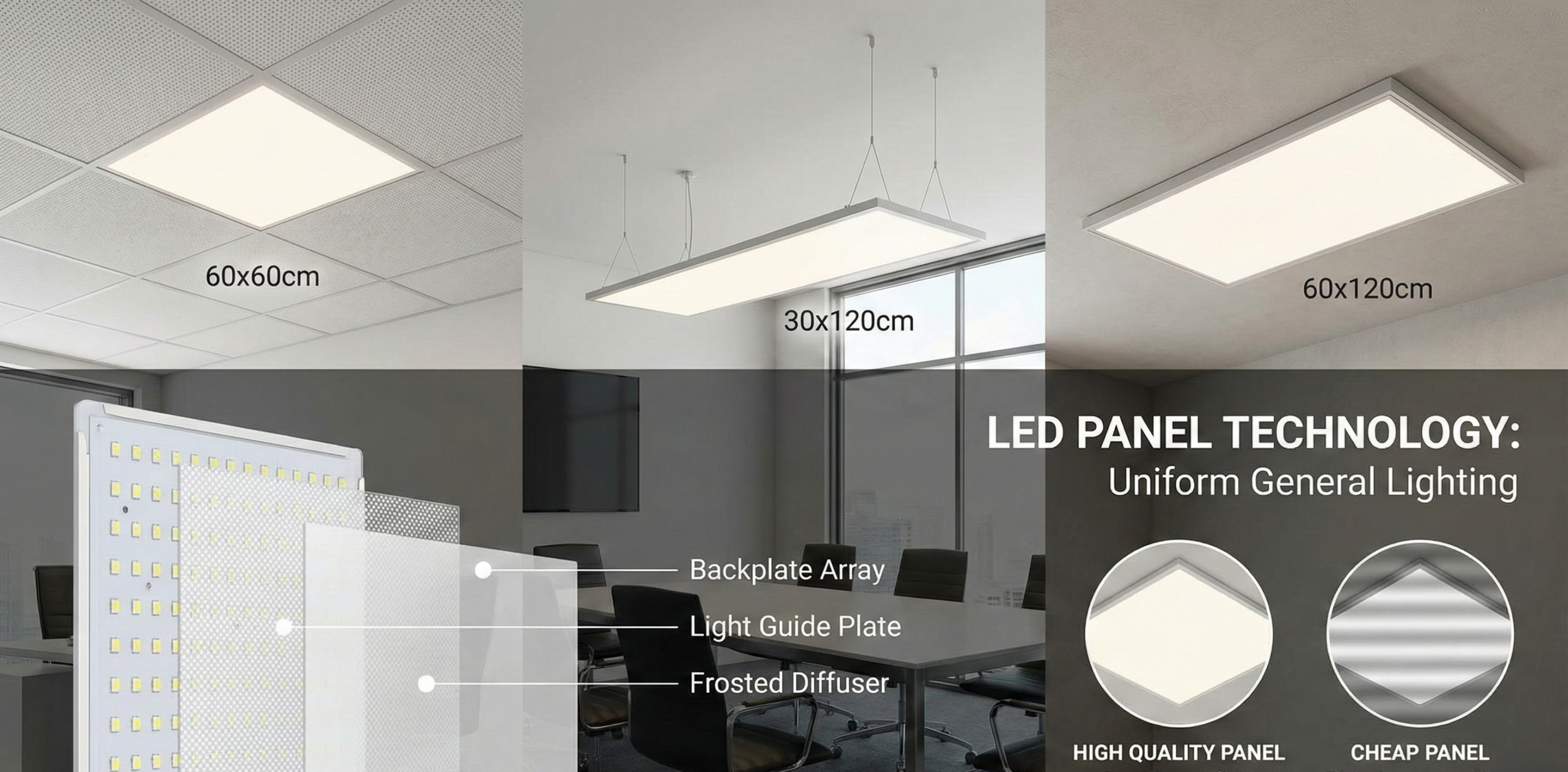
LED panels are designed for uniform general lighting . They provide a wide and “soft” light field, typically in 60×60, 30×120 or 60×120 cm. The panels are most often used in offices, schools, healthcare, meeting rooms and retail spaces where you want a tidy look and a comfortable, diffused lighting. They can be mounted in a system ceiling, recessed into plaster, surface-mounted in a frame, or suspended from a wire.
What makes an LED panel an LED panel is the light surface : a large area that spreads the light, often via a diffuser and a light guide plate. The result is lower point glare than many “spotty” solutions. But here comes the first trap: not all panels are the same. Cheap panels can provide an uneven light surface, poor color rendering and flicker from the driver. If you are going to use panels in rooms where people work for a long time, you have to think a little further than “it was on sale”.
What is a fixture, and why are there so many?
Luminaire simply means “lighting equipment” that provides light where you need it. It can be anything from linear luminaires for warehouses and industry, downlights , tracks with spotlights , sealed luminaires (IP65) for wet rooms and parking garages, or high bays for high ceiling heights. The luminaire is less about “flat light surface” and more about the right light distribution, the right enclosure, the right control and the right robustness for the environment in which it will be installed.
Luminaires are often chosen when you have more specific needs: you need to reach down to a work surface from a high ceiling, you need a narrow beam, you need to withstand dust and moisture, or you want flexible lighting with zones and accent lighting. Luminaires often give you more options for optics (beam angle), degree of protection, and mechanical quality.
The main differences in practice
The concrete difference between LED panels and luminaires is about four things: light distribution, application, installation and performance over time .
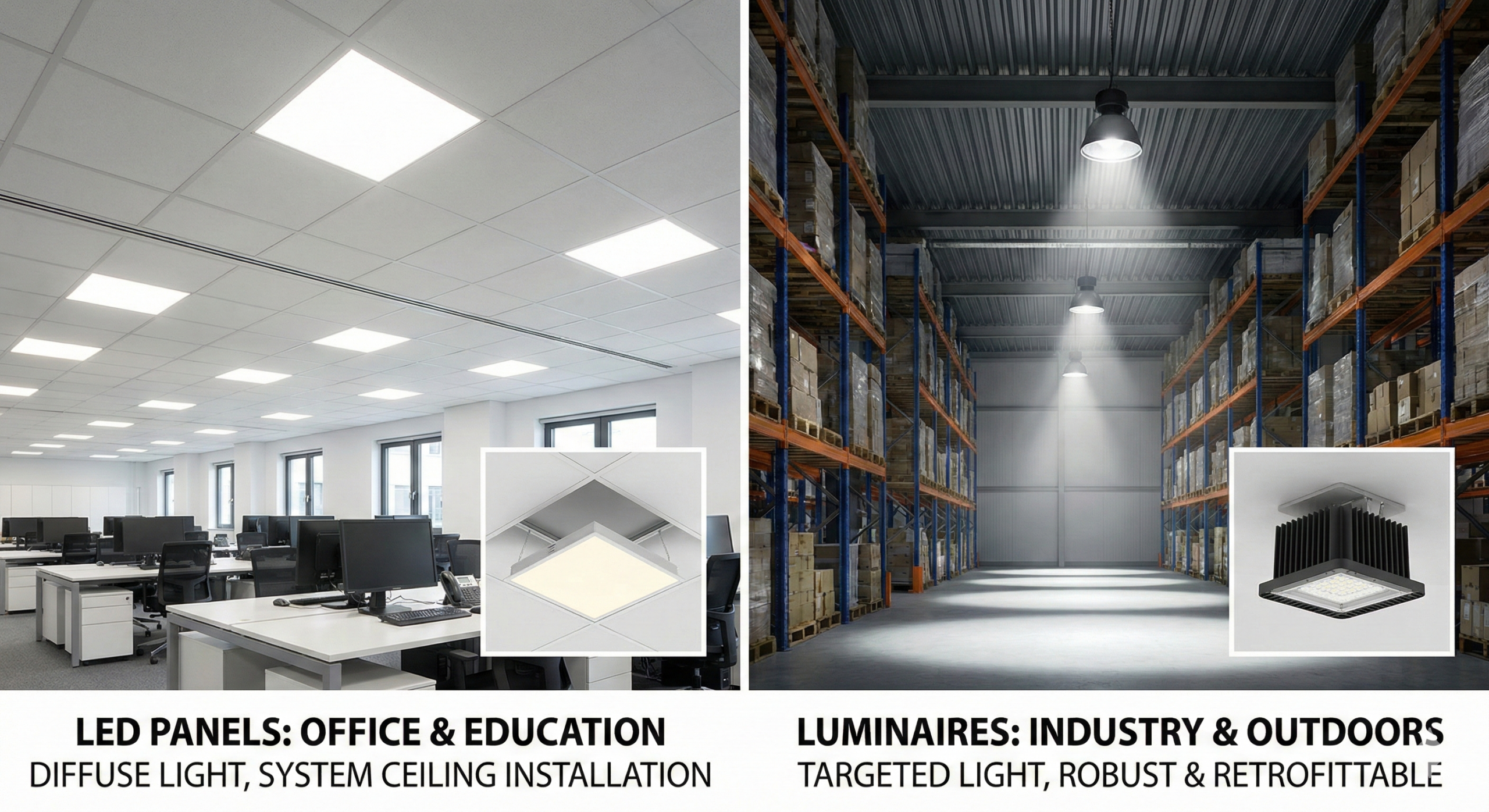
Light distribution: LED panels provide a wide, diffuse light distribution that is suitable for even lighting. Many other fixtures are more “targeted”: they can throw the light further, focus it more narrowly, or provide better vertical lighting on walls and shelves. If you want to make a store look premium, panels alone are rarely enough. You often need fixtures that can work with contrasts.
Application: Panels dominate in office and educational environments. Luminaires dominate in industry, warehouses, outdoors, wet rooms, and places with demanding environmental requirements. A rule of thumb: The more demanding the environment, the more likely that “classic luminaire” is correct.
Installation: Panels often require specific ceiling solutions (system ceiling, recessed or frame). Luminaires are available in several mounting variants and are often easier to retrofit without rebuilding the ceiling.
Performance and quality: Both can be top or bottom. But typically you get more industry-specific quality choices on luminaires: better thermal management, better optics, higher enclosure ratings, and often longer life expectancy in harsh conditions. Panels can be amazing, but they are more vulnerable to the “cheap driver” syndrome: flickering, early failure, and poor dimming compatibility.
What you should check before choosing
If you actually want a solution that both looks good and lasts, you should check these points regardless of whether you choose an LED panel or fixture:
- Brightness (lumens): Look at lumens, not just watts. Watts are power consumption, not light output.
- Color temperature (kelvin): 3000K for warm and pleasant, 4000K for neutral and efficient.
- Color rendering (CRI): CRI 80 is standard, CRI 90+ for places where colors matter (store, healthcare, showroom).
- Glare control (UGR): For offices, you should often aim for low UGR for comfort.
- Driver quality: Flicker and dimming are often present in the driver. Good driver = more stable light and longer lifespan.
- Protection rating (IP): IP20 keeps indoors dry. If you need dust/moisture protection, look for IP44, IP54, IP65.
- Lifespan and warranty: Look for serious specifications and a warranty you can actually trust.
What should you choose, when?
If the goal is uniform, attractive general lighting in rooms with normal ceiling heights, LED panels are often the most cost-effective and aesthetic choice. Typical winners: offices, hallways, meeting rooms, clinics, receptions, schools.
If you need robustness, reach, flexibility or more controlled light , you should look at the right luminaire types instead. Typical winners: warehouses, workshops, underground parking garages, outdoors, wet rooms, shops requiring accent lighting, and premises with high ceilings.
The somewhat honest mentor version: If you choose a panel “because it’s easy”, but the application actually requires industrial luminaires, you get a solution that works on paper and is annoying in practice. The right product for the right environment always beats “cheapest possible, fastest possible”.
Summary
The difference between LED panels and luminaires is not just words. LED panel is a specialized luminaire for even, diffused light, while “luminaire” covers all lighting solutions with different optics, housings and applications. Choose panel when you want a neat look and comfortable general lighting. Choose the right luminaire when the environment, ceiling height or lighting needs are more demanding.
At polybrite.no, the goal is simple: that you buy right the first time, and avoid having to “upgrade out of irritation” in six months.