LED has practically won the lighting war. It is energy efficient, has a long lifespan and gives you flexibility in everything from offices to warehouses and shops. However, there is a classic trap that many people fall into: flicker. It is the type of “invisible irritation” that is not always detected in an inspection, but which becomes very visible when employees get headaches, get tired eyes or complain that they feel unwell under the light. In other words, LED flicker is not a cosmetic problem. It is a quality and HSE issue, and it affects both well-being and performance.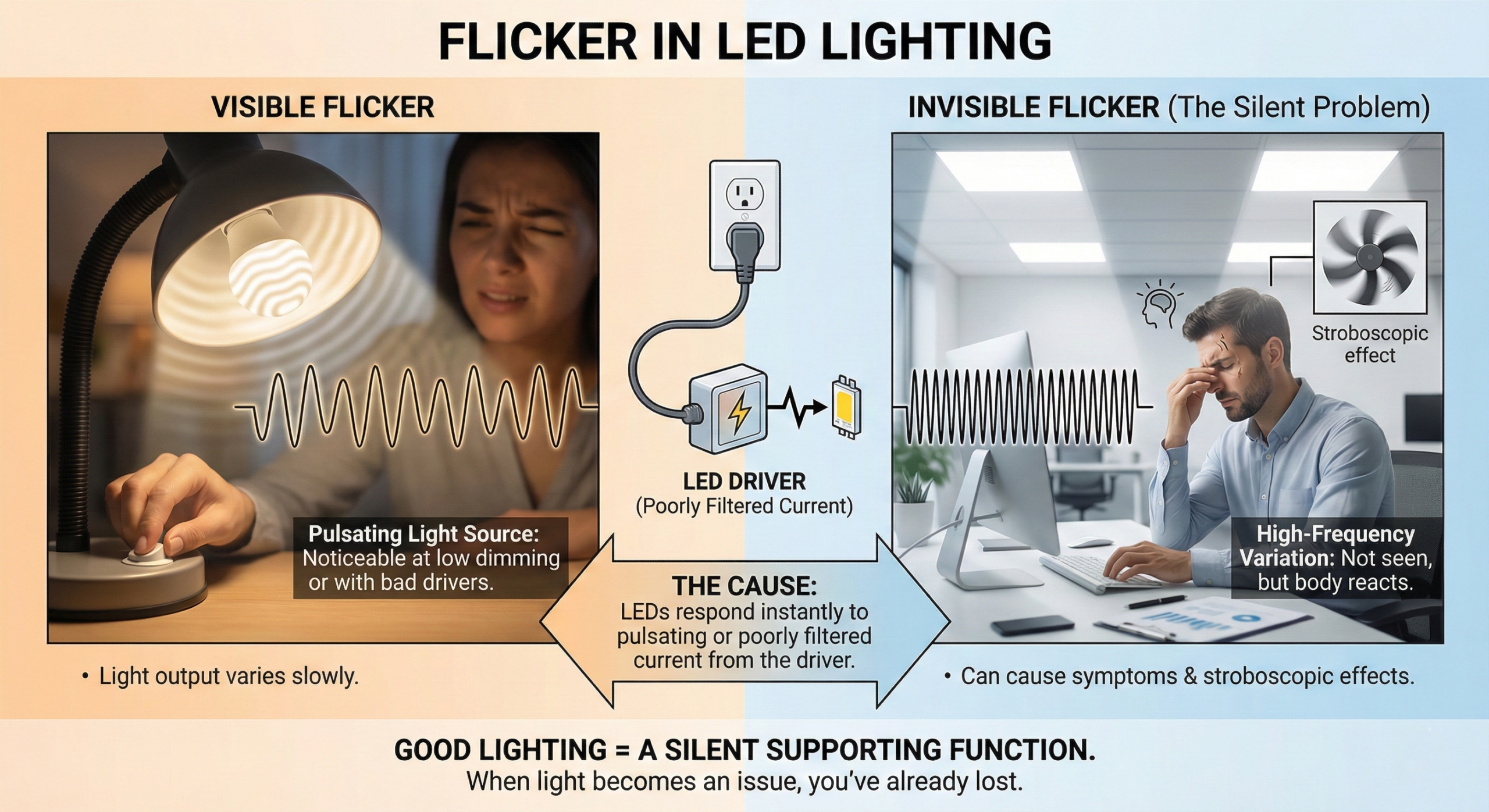
What is flicker in LED lighting?
Flicker means that the brightness varies over time. It can be visible, but often it is so high in frequency that you do not “see” it directly. Your body can still react. The reason is that the LED itself responds extremely quickly to changes in current. When the power supply (driver) delivers a pulsating or poorly filtered current, you get pulsating light.
In practice, you get two main types of problems:
- Visible flickering : You notice that the light pulsates, especially at low dimming or with bad drivers.
- Invisible flicker : You can’t see it, but it can cause symptoms and create stroboscopic effects (more on that soon). This is the dangerous variant, because it gives you «no apparent cause» and thus many fallacies.
And no, it’s not just «someone complaining a little». Good lighting should be a silent supporting function. When light becomes an issue in itself, you’ve already lost.
Why does LED flicker occur?
The short version: the driver and the dimming .
Many LED fixtures are controlled with a driver that converts 230V AC to a suitable DC current for the LED module. If the driver is cheap, undersized or designed with weak filter components, it will let through ripple (waves) that cause the light to pulsate.
The other classic is dimming via PWM (Pulse Width Modulation). PWM turns the LED on and off quickly instead of lowering the current “nicely”. When the PWM frequency is low, or when combined with a driver that does not handle this well, you get flickering that can be both noticeable and annoying. On paper, everything may look “compatible”. In reality, you get a workplace that feels like an old disco, only without the music and with more irritation.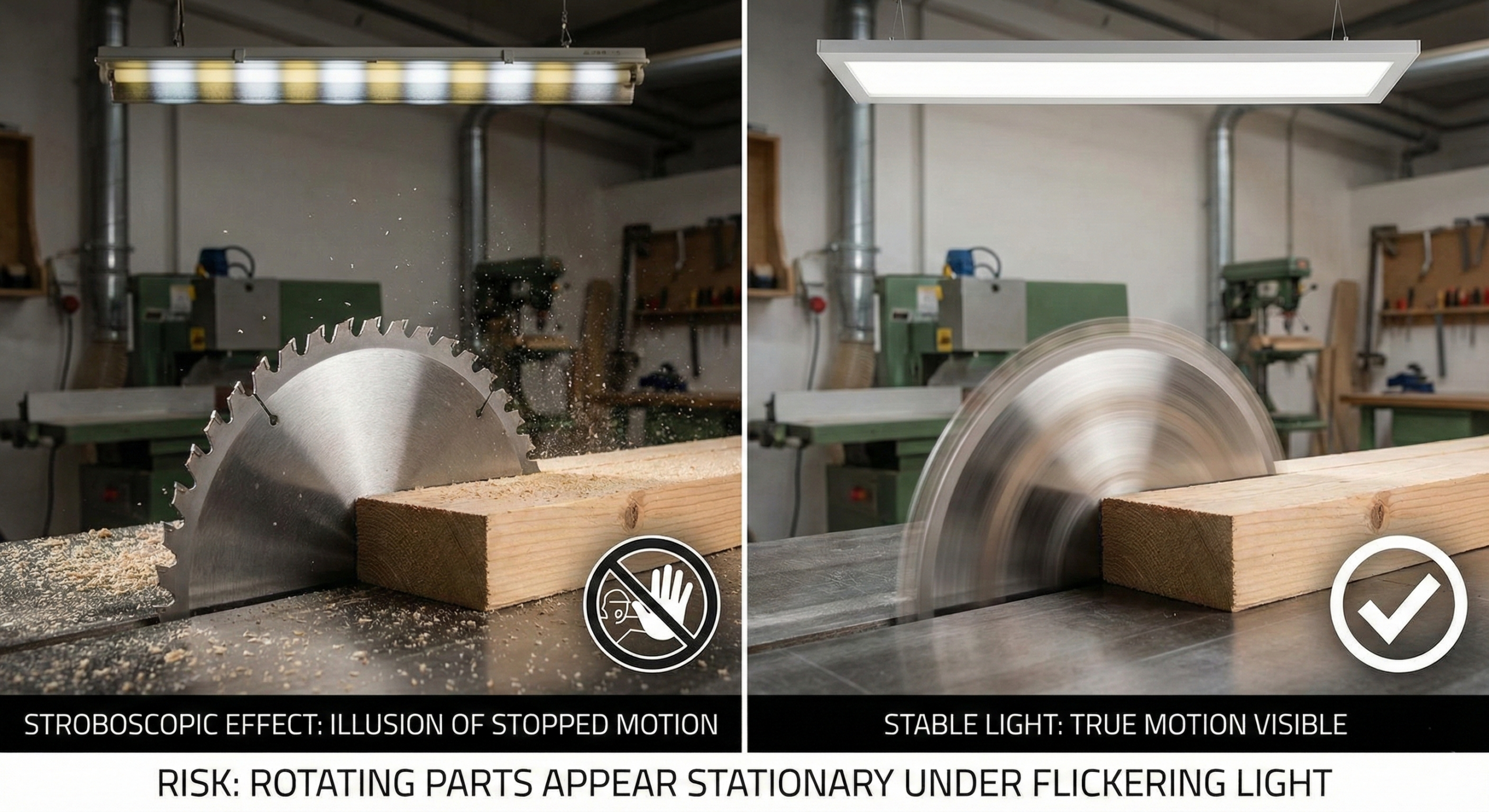
Stroboscopic effect: When machines appear “stopped”
This is an underestimated risk. Flicker can create a stroboscopic effect , which makes rotating parts (fans, drills, saw blades, motor shafts) appear to be stationary, or running slower than they actually are. In industrial environments this is obviously critical, but also in workshops, warehouses and production lines it is a real HSE issue.
Even in the office, the stroboscopic effect can cause discomfort in your peripheral vision, especially when you move your eyes quickly between the screen, keyboard, and paper. It becomes a type of “microstress” that you don’t need.
Typical symptoms of problematic fibrillation
Flicker does not affect everyone the same. Some people don’t notice anything. Others react quickly. Common signals in an organization are:
- Headache that increases throughout the day
- Tired or dry eyes
- Loss of concentration and “brain fog”
- Restlessness, nausea or general discomfort
- Complaints that disappear when working at home or in other premises
If you hear this after an LED upgrade, it’s not “getting used to it.” It’s a warning shot.
How is flicker measured?
Many people are fooled here, because the market loves vague formulations like “flicker-free.” It often means nothing without a measurement method and numbers.
Two concepts you should know:
1) Percent Flicker / Flicker Index
Classic measures that tell us something about brightness variation. They can be useful, but they don’t always capture everything, especially with complex waveforms.
2) SVM (Stroboscopic Visibility Measure)
More modern and relevant for “invisible flicker” and stroboscopic effects. Lower is better. In many professional contexts, SVM is a better control parameter.
In addition, there are recommendations and standards used in the industry (for example, IEEE 1789 for assessing flicker risk). Your point is not to become a lighting engineer. The point is to demand documentation that can actually be verified.
What should you require when buying LED for your office, school, shop or industry?
If you want a simple decision basis, use this logic:
1) Quality driver with documented low flicker
The driver is the heart of the fixture. It should be from a reputable manufacturer, have stable current regulation and documented flicker data.
2) The right dimming technology for the application
Dimming is often where flicker appears. DALI, 1–10V, phase cut or PWM can work, but only if the driver and dimmer are designed for each other. “It usually works” is not a specification.
3) Think holistically: flicker, UGR, lux and colour temperature
You can have flicker-free lighting that is still poor if the glare (UGR) is wrong, the lux level is too low, or the colour temperature does not match the task. The best solutions balance all of this.
4) Ask for numbers, not just words
Ask the supplier to provide flicker data and measurement method. If they can’t answer, you have your answer.
Myths that should die (preferably before the next round of purchases)
“LED does not flicker.”
Wrong. LEDs can flicker more than traditional solutions if the driver is bad.
“If I can’t see it, it doesn’t exist.”
Wrong. Invisible flicker can still affect comfort and performance.
“It’s only dimming that causes flicker.”
Often yes, but poor power supply can cause flicker even without dimming.
“Cheap luminaire + expensive dimmer solves it.”
Usually no. Driver and luminaire design set the limitations.
What does this mean in practice for you as a buyer?
If you’re buying LED lighting for a commercial space, flicker is one of the things you need to “lock down” early on. It’s not something you want to improvise on after everything is installed. Once you have 200 fixtures in your ceiling, troubleshooting becomes an expensive hobby.
For Polybrite customers, the goal is simple: You should be left with a solution that works in operation, not just on a quote sheet. This means that the products must be suitable for the right application, and that the driver/dimming is chosen consciously. When done right, you get LED that delivers lower energy costs without sending your employees into a paracetamol budget meeting.
Conclusion: Flicker is not “detail” – it is quality
LED flicker is basically about two things: the quality of the power management and how the light is used in practice . If you take flicker seriously, you reduce the risk of discomfort, increase comfort and get an installation that can withstand everyday use. If you ignore it, you can end up with an “upgrade” that creates more noise than light.
If you want to be safe: Choose LED solutions with documented low flicker, the right driver and well-thought-out dimming. Then you get what LED really should be: stable, efficient and completely undramatic. That’s exactly how lighting should be.